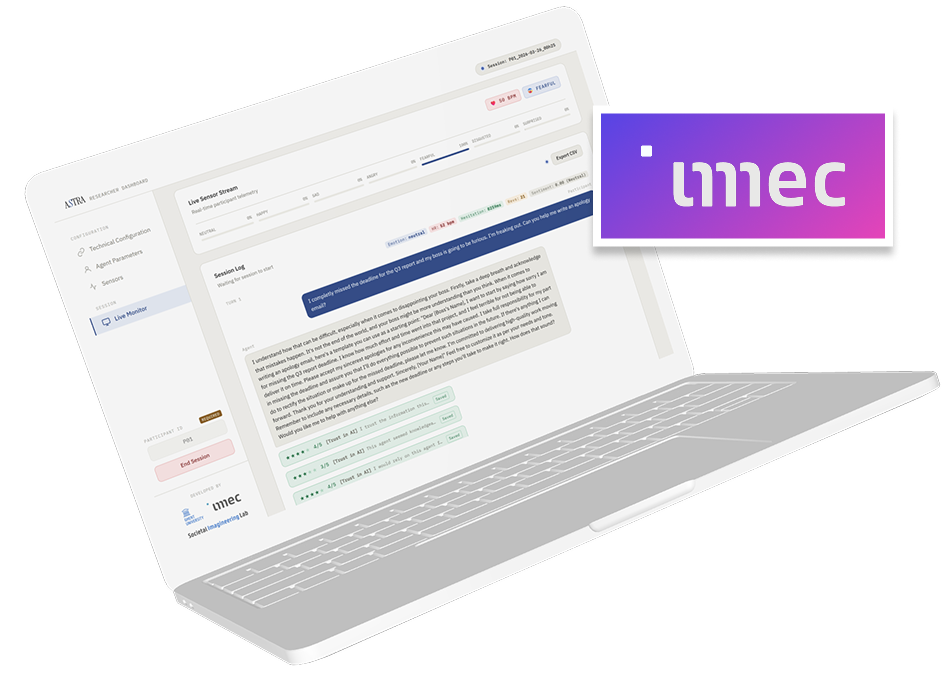
ASTRA: Building a modular testing platform for conversational AI (ongoing)
Developing a scalable, AI-driven environment to evaluate and optimize human interaction with conversational agents.
Developing a scalable, AI-driven environment to evaluate and optimize human interaction with conversational agents.
As conversational AI becomes deeply integrated into daily life, understanding how users build trust and communicate with these agents is critical. ASTRA is an ongoing project for Imec and Ghent University aimed at building a robust testing platform to track, and evaluate user-AI agent interactions by implementing adjustable agent parameters (e.g., level of explainability) and live sensors (e.g., facial emotion recognition) to track user behavior in real time.

To bring this concept of a human-agent interaction testing platform to life, Claude Code and Google Stitch were leveraged to co-create the platform’s core functionalities and initial interface design. To ensure high-quality outputs from the LLMs, our prompt engineering strictly adhered to the RTCCF framework (Role, Task, Context, Constraints, and Format). This AI-driven ideation phase allowed us to rapidly map out and visualize our very first conceptual model.
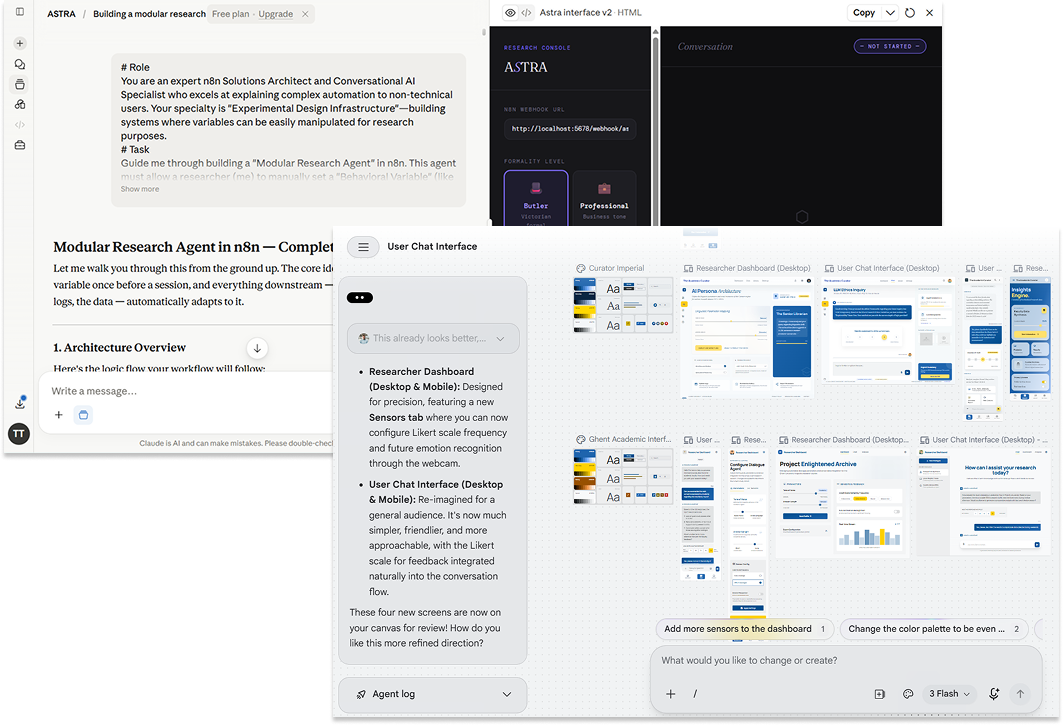
With the concept and visual style defined, we deployed a diverse AI tech stack to translate static designs into a functional Proof of Concept (POC). Using these tools we advanced from an initial concept to a live, testable prototype in just a few weeks using the following stack:
Claude Code & Gemini): Leveraged "vibe-coding" workflows to rapidly build out the main application interface.n8n): Constructed the core logic, API connections, and custom toolsets. To power the system's "brain," we built an adaptive architecture that dynamically leverages diverse LLMs, including Gemini, Mistral and Ollama.ElevenLabs): Embedded advanced audio models to give the agent a natural, conversational voice.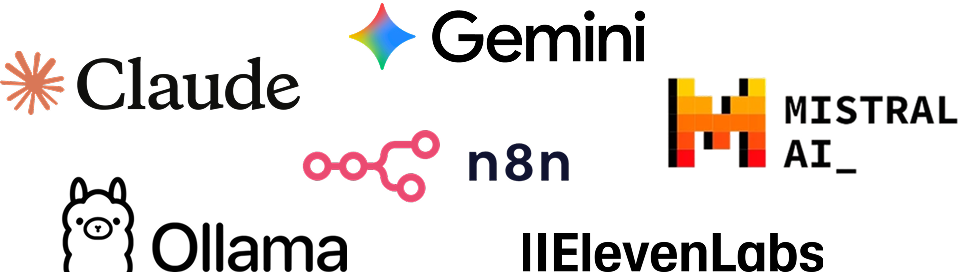
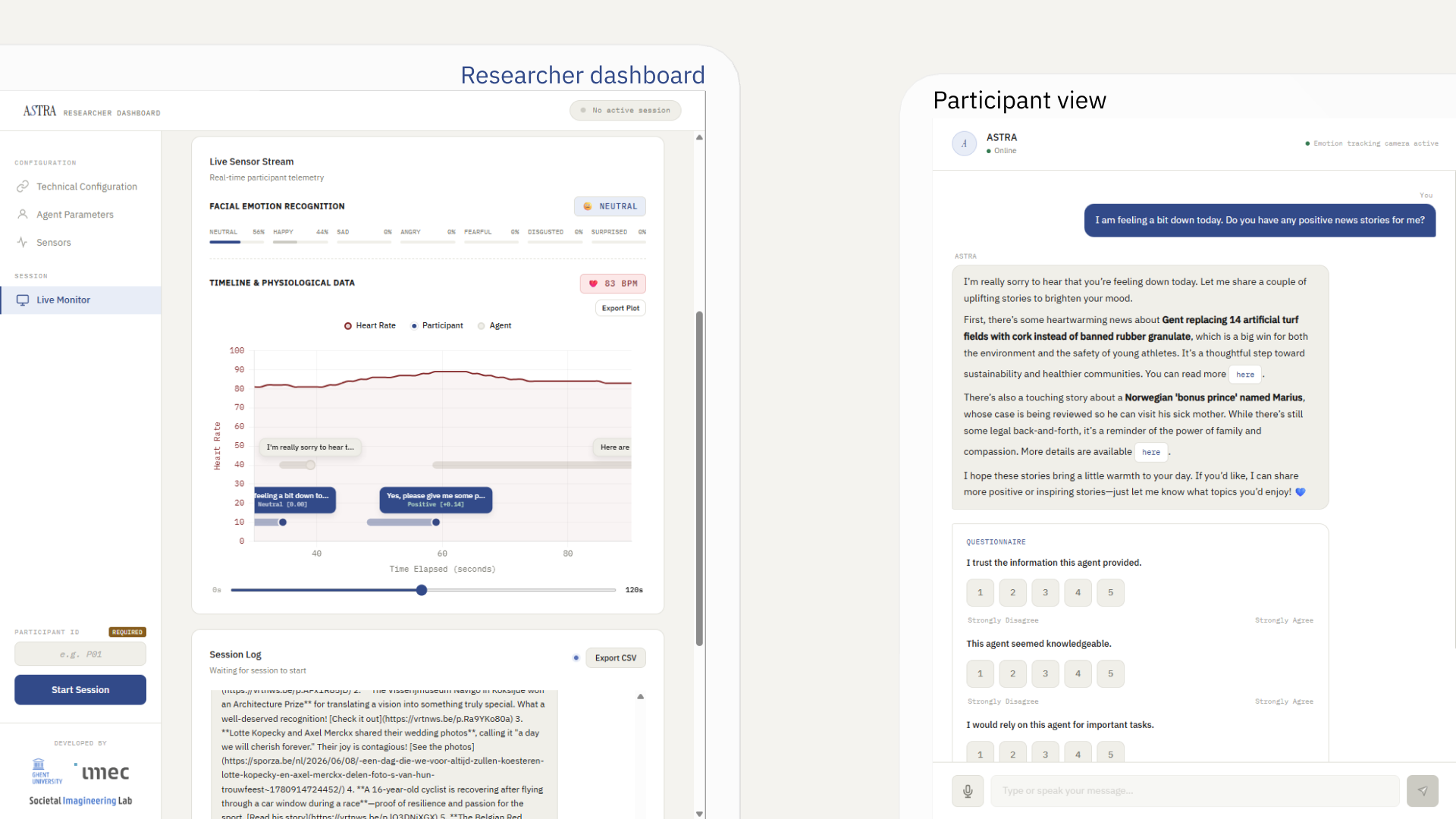
ASTRA operates through a dual-interface architecture: the Researcher Dashboard and the Participant Chat Interface.
The Researcher Dashboard acts as the study's mission control room, allowing researchers to:
The Participant Chat Interface
To the person testing the system, ASTRA functions as a simple, distraction-free chat application. While they are interacting with the AI, the platform records their physical and emotional reactions in the background, which are immediately visualized on the researcher's dashboard.
With the core platform built, the focus for ASTRA is shifting from development to testing it in the wild. The immediate next step is to conduct user testing using real-world use cases to see how the platform and its sensors perform in practical, everyday scenarios. The insights gathered from these live sessions will guide the next phase of the project; helping us refine the platform, integrate new tracking capabilities, and eventually scale the platform so other researchers and companies can use it to study human-AI interaction.
